Our Story
The Meaning of
Komorebi Mokuyoku
木漏れ日 · 木浴
Sunlight filtering through trees. Forest bathing. This is not just a name — it is a frequency, rooted in 6,000 years of indigenous stewardship and the ancient art of healing through nature.
The Words
A Name That Carries
Ancient Resonance
木漏れ日
Komorebi
(koh-moh-REH-bee)
The interplay of sunlight filtering through the leaves of trees. In Japanese, it describes that specific, almost sacred quality of light that dapples through a forest canopy — the moment where heaven meets earth, where light becomes visible through living structure. It is enlightenment through nature.
木浴
Mokuyoku
(moh-koo-YOH-koo)
Literally "wood bathing" or "forest bathing." The act of immersing oneself completely in the forest environment — not as exercise, not as sightseeing, but as dissolution. The ego dissolves into the interconnected web of roots, canopy, river, and stone. It is the practice of becoming part of the forest itself.
Together:
Light + Wood = Sun + Tree = Heaven + Earth
That union is literally what Big Sur represents. Cliffs rising vertically from the ocean, rivers flowing through ancient canyons, sunlight piercing the redwood canopy. Komorebi Mokuyoku is not a brand — it is a description of this place.
Sacred Geometry & Numerology
The Vibrational Blueprint
Komorebi
The Mystic
K(2)+O(6)+M(4)+O(6)+R(9)+E(5)+B(2)+I(9) = 43 → 7. Inner wisdom, nature attunement, sacred solitude, esoteric knowledge, retreat energy.
Mokuyoku
The Master Healer
M(4)+O(6)+K(2)+U(3)+Y(7)+O(6)+K(2)+U(3) = 33. A rare Master Number. Compassion, sacred service, elevated consciousness, healing through environment. Known as the universal caregiver frequency.
Combined
Foundation / Earth
7 + 33 = 40 → 4. Stability, the earth element, physical grounding, building something lasting. Aligned with the 5-acre canyon, ancient redwood roots, and the river's flow within structure.
Geometric Archetypes
Vesica Piscis — Komorebi
Two circles overlapping: the sun (light) and the tree canopy (matter). The light piercing through creates a sacred portal. Palo Colorado Canyon literally embodies this geometry — the ocean horizon, vertical redwood trunks, and the river cutting through earth form a natural vesica where worlds intersect.
Flower of Life — Mokuyoku
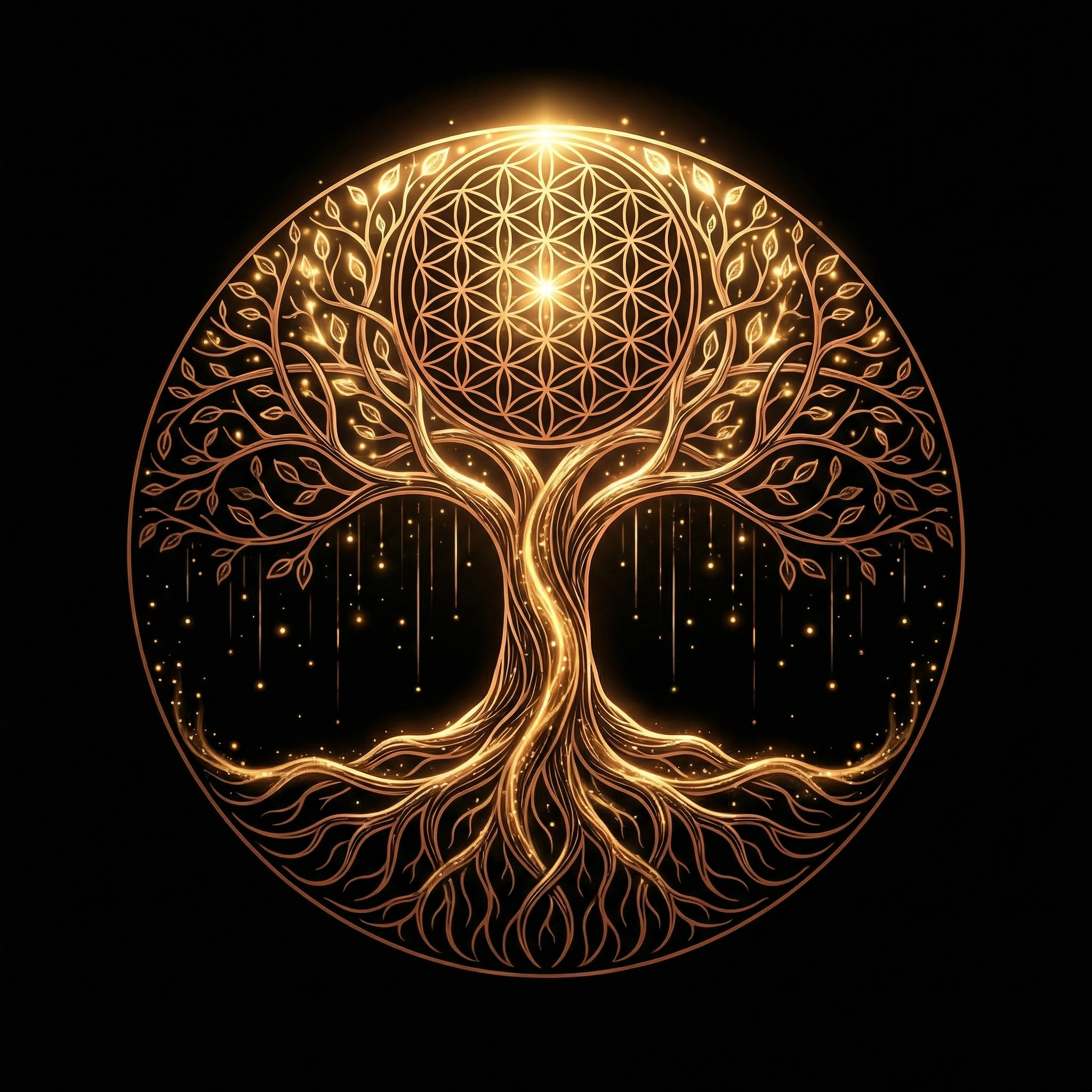
Forest bathing is immersion in interconnected life. The Flower of Life represents cellular regeneration, breath and geometry, harmonic resonance. Big Sur's old-growth redwoods grow in circular root networks — they literally form living mandalas underground, each tree connected to every other in an invisible web of shared nutrients.
The 4-Element Activation Field
The numerology 4 (foundation / elements) manifests physically in the property itself.
The First Stewards
The Esselen People
6,000 Years of Forest Communion
Long before the Japanese coined the term Shinrin-yoku in 1982, the Esselen people of the Santa Lucia Mountains lived in complete immersion with these very forests. They did not need a word for forest bathing — because it was not a practice. It was simply life.
Guardians of the Santa Lucia
The Esselen are among the smallest and least-known indigenous groups in California, yet their presence in this landscape stretches back over six millennia. Their territory encompassed the rugged canyons, old-growth redwood forests, and year-round rivers of what is now the Los Padres National Forest — including Palo Colorado Canyon, where Komorebi Mokuyoku stands today.
Organized into five districts — Excelen, Eslenahan, Imunahan, Ekheahan, and Aspasniahan — the Esselen numbered between 1,185 and 1,285 people. They spoke a language so ancient and distinct that linguists consider it may be the last remnant of a language family that once extended to the San Francisco Bay, gradually displaced over thousands of years.
They are known for their unique handprint rock art found in caves throughout the interior mountains — red and white ochre hands pressed against stone, a gesture of presence that has endured for millennia. They crafted elderberry clapper sticks for ceremony, wove intricate baskets, and built hemispherical domed dwellings that echoed the curves of the hills around them.
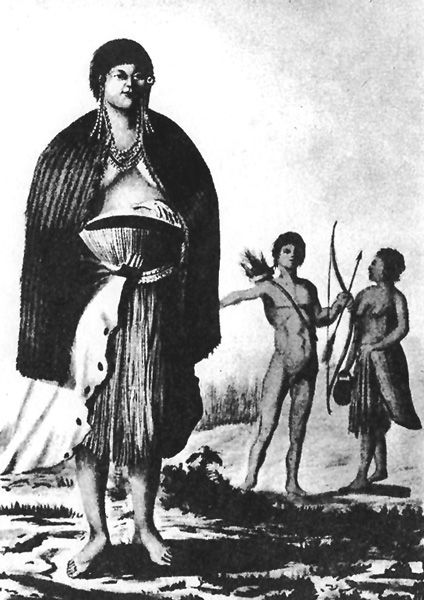
Historical illustration of Esselen people of the Monterey coast region. Image courtesy of Legends of America.
Pico Blanco — Center of the Esselen World
The Esselen creation story, recorded by anthropologist Alfred Kroeber in 1907, tells of Eagle, Hummingbird, and Coyote gathered atop Pico Blanco — the white peak visible from Palo Colorado Canyon. When the great flood came and waters rose, Eagle flew to the Sierra de Gabilan carrying the seeds of renewal. This mountain, visible from our property, remains the spiritual center of the Esselen world.
The Esselen understood what modern science is only now confirming: that deep, sustained immersion in old-growth forest environments produces measurable changes in human physiology — reduced cortisol, enhanced immune function, lowered blood pressure, and a profound sense of interconnection with the living world.
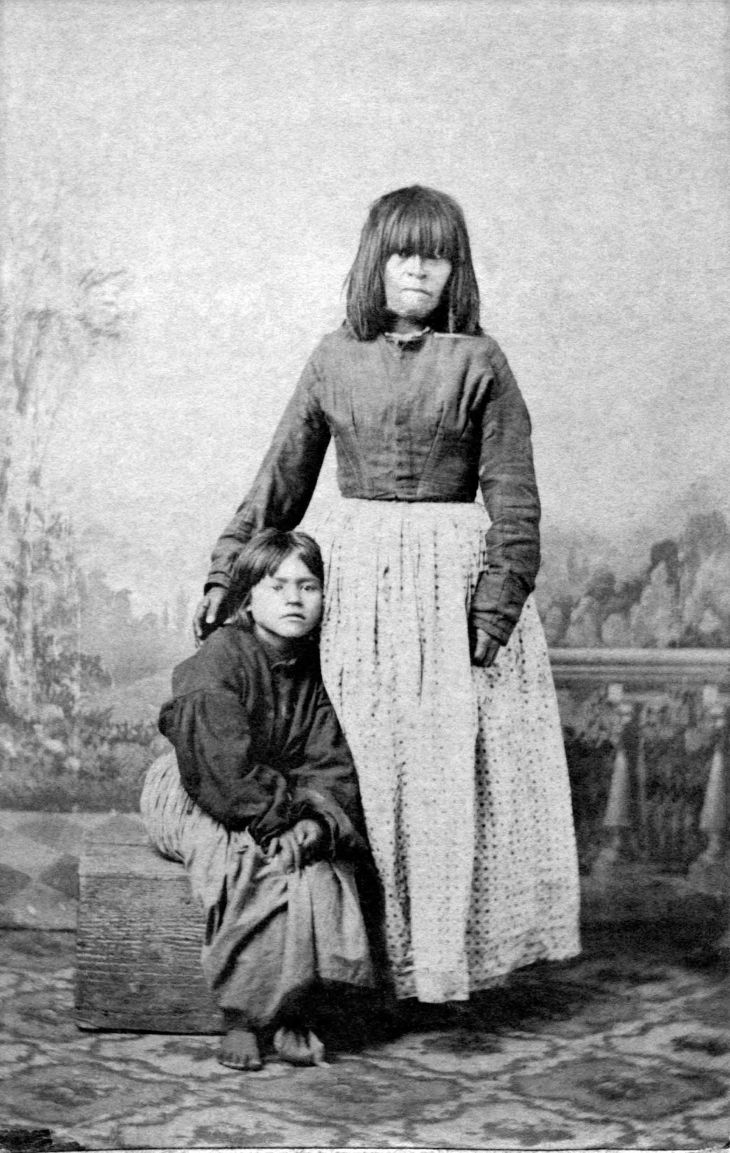
California Indian mother and child, ca. 1890s. Historical portrait from the Monterey region.
Displacement, Resilience, and Return
When the Spanish missions arrived in 1770, the Esselen world was shattered. Some 900 Esselen were gathered into the missions at Carmel, Soledad, and San Antonio — forbidden from speaking their language, practicing their traditions, or returning to their forests. The indigenous population of the Monterey area declined by an estimated 90% during the Mission Era.
Often cited as the first California group to become "culturally extinct," this narrative is wrong. Some Esselen escaped the missions entirely by retreating into the rugged interior mountains — the very canyons and ridges that surround our property. Hundreds of descendants survive today, carrying forward traditions passed from generation to generation through centuries of displacement.
In 2020, the Esselen Tribe of Monterey County reclaimed 1,199 acres of ancestral land near Big Sur — their first ancestral homelands since displacement by the Spanish over 400 years ago. Oak woodlands and redwood-shaded riverbanks, returned at last to the people who first named the rivers and knew every root of every tree.
Two Traditions, One Truth
From Esselen Stewardship
to Shinrin-yoku
In 1982, Tomohide Akiyama, head of Japan's Ministry of Agriculture, Forestry, and Fisheries, coined the term Shinrin-yoku (森林浴) — forest bathing. The concept drew from Shinto traditions of sacred groves (chinju no mori) and Buddhist forest meditation, articulating something that indigenous peoples worldwide had always known: that deep immersion in forest environments heals the human body and spirit.
Six thousand years before that word existed, the Esselen people of this very canyon were living it. Their entire existence was forest bathing — waking among the redwoods, bathing in the rivers, gathering acorns beneath the canopy, pressing their hands against cave walls in gestures of belonging. They practiced non-extractive spirituality: quiet reverence, light-based awakening, healing through environment.
Komorebi Mokuyoku bridges these two traditions. The Japanese language gave us the words. The Esselen gave this land its spirit. When you walk among the old-growth redwoods of Palo Colorado Canyon, when you submerge in the cold river and warm in the barrel sauna, when you sit in silence and hear only the creek and the wind — you are participating in a practice that is both ancient and timeless, both Japanese and Esselen, both named and beyond naming.
A Timeline of Forest Communion
Esselen people establish permanent presence in the Santa Lucia Mountains and Big Sur coast
Esselen handprint rock art created in interior mountain caves — marks of belonging
Spanish explorer Sebastián Vizcaíno first visits the Monterey coast
Mission San Carlos founded; Esselen displacement begins
Missions disbanded; surviving Esselen retreat to the interior mountains
Alfred Kroeber records the Esselen creation story of Pico Blanco
Japan coins Shinrin-yoku (森林浴) — giving modern language to an ancient practice
Esselen Tribe reclaims 1,199 acres of ancestral Big Sur land
Komorebi Mokuyoku opens — bridging Esselen stewardship and Shinrin-yoku on this sacred ground
Our Commitment
Honoring the Land
Komorebi Mokuyoku operates on ancestral Esselen land. We acknowledge this with deep respect and a commitment to stewardship that honors the traditions of the people who cared for these forests for thousands of years before us. Our approach to wellness is rooted in the same principles the Esselen practiced: non-extractive, reverent, and in service to the living landscape.
We are committed to supporting the Esselen Tribe of Monterey County in their ongoing work to reclaim and protect their ancestral homelands, preserve their cultural heritage, and share their deep knowledge of this sacred landscape with future generations.
"Komorebi Mokuyoku carries respect for nature, non-extractive spirituality, quiet reverence, and light-based awakening. It is gentle but powerful. It whispers instead of announces."
What This Place Is
Not
- A spa
- A retreat center
- A hotel
- A resort
But
- A ritual immersion
- A pilgrimage site
- A seasonal activation
- A consciousness sanctuary
Subtle luxury. It whispers instead of announces.